- About CPFE
- Fee & Course Calender
- Why Choose CPFE
- Faculty
- Course Outline
- Career Opportunities
- Finance your Study
- Faqs
Certificate Program in Financial Engineering (CPFE®)
Build your career in Quants & Financial Engineering
- English
-
Indian Institute of Quantitative Finance
- Book a guidance call
Quick Facts
- Program Duration
- Program Schedule
- Program Timing
- Program Start Date
CPFE® Program | Financial Engineering Course Highlights
- World Class Faculty: Learn from highly acclaimed Quant practitioners and academics in Quantitative Finance who have worked with topmost global investment banks and firms in New York, London, Singapore, Sydney and more, with academic background from some of the world’s top universities like Stanford (USA), Columbia (USA), IIM, IIT, ISI.
- Industry focused curriculum: Advanced curriculum designed by Quant practitioners from top Wall Street Investment Banks and financial institutions and industry experts to prepare job-ready professionals who are highly sought after by International Banks, Hedge Funds, Consulting Firms and other Financial Institutions.
- Rigorous Practical Implementation: Learn how to combine theory and computational methods with strong emphasis on practical implementation in Python of the real-world application areas of these skills.
About CPFE® Course
Financial Engineering Courses (CPFE) prepare students for technically sophisticated jobs with financial institutions, financial service providers, financial consulting services and financial software companies. The program is intended for students seeking comprehensive technical knowledge of vanilla and exotic derivatives pricing, hedging, trading and investment strategies and portfolio management in equity, currency, interest rates, credit and mortgages.
CPFE is a short-term course that requires seven months of study for the core modules, which makes it attractive to students with strong quantitative skills who are willing to make a quick head start in the investment finance industry. The applied nature of the program implies the fact that there is great emphasis in it to impart the practical implementation skills and techniques that are actually used by practitioners in top financial institutions in the industry, so a considerable part of the course time is devoted to teaching implementation skills along with rigorous theoretical discourse.
As an applied discipline, financial institutions look for the following skill sets in the candidates for positions in their Quant teams :
- Strong quantitative background
- Sound knowledge of the underlying financial theories
- Very good implementation skills
This Financial Engineering course is designed specifically to meet these exact needs. This is a course on modelling and applications of mathematics, statistics and econometrics in investment finance. The program covers all the technical and quantitative aspects of investment finance used in top financial institutions.
The combination of skills imparted through this program viz. understanding of complex financial theories, rigorous exposure to the underlying mathematical and statistical theories, practical financial modeling ability and computer implementation proficiency, is in high demand in the industry, and which the employers do not generally find in graduates of standard MBA or financial engineering programs.
CPFE® Course Calendar
- Main Modules 320 Hours (7 Compulsory Modules)
- 4 Primers: Each primer is of approx. 40 Hours duration.
| Batch | Start Date | Fee | Mode | Time |
|---|
Why choose CPFE® Program?
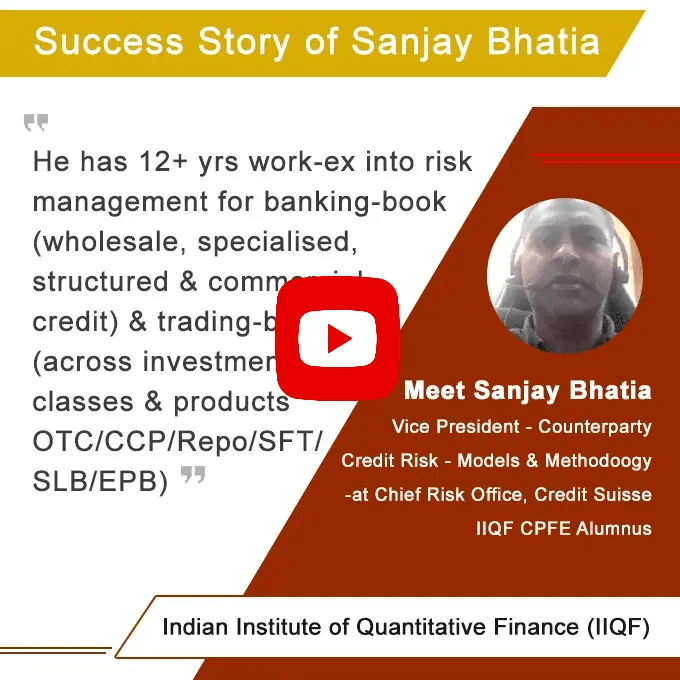
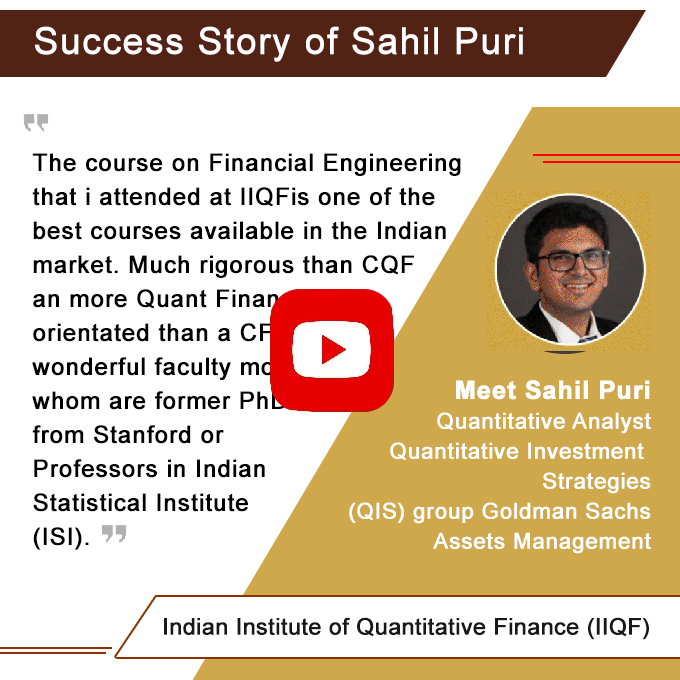
View what our learners have to say...
Faculty
Dr. Amit Ram
"Ph.D. (Statistical Physics and Computational Methods) Stanford University (USA) B. Tech. (Engineering Physics) IIT (Bombay) Over 10 years of experience working in Lehman Brothers (New York), JP Morgan Chase (New York), Standard Chartered (Singapore), Nomura (Mumbai)"
More...Dr. Samir Ranjan
"Ph.D. (Theoretical Physics) Purdue University (USA) MS (Mathematical Finance) Columbia University (New York) Over 10 years of experience working as Financial Engineer with Bonddesk Group in New Jersey (USA)"
More...Ritesh Chandra
"MBA IIM Calcutta B. Tech. IIT Kanpur and CFA (Level 3 Pass) More than 11 years of experience in Credit Risk, Corporate Finance & Technology and has worked in India, China and Canada in a variety of roles"
MoreSrijoy Das
"B. Tech, IIT Kanpur. Srijoy Das has more than 15 years of experience in Quantitative analysis and research that includes areas such as Derivatives Pricing, Market and Credit risk and has worked in India, USA & UK in a variety of roles in international banks and consulting firms. His more recent projects over last 4 years include model risk assessment of counter-party risk models and regulatory stress testing (CCAR, EBA) models for leading investment banks.Further he is a thought leader and a scholar who likes to connect with, influence and inspire his audience through writing, speaking, lecturing and debating and using world class network of resources that include theories, best practices and subject matter."
MoreRupal
"B.Tech IIT, Kanpur Rupal has a vast experience of more than 12 years in various areas of finance. He currently works as Vice President, Fixed Income at one of the largest International Bank for their Corporate Investment Banking Division. Prior to this he was working as Assistant Vice President at Credit Suisse, Investment Banking Division. He also has been a regular internal trainer in the organizations that he has worked in.
MoreUjwal Dinesh
"MBA (IIM Calcutta) BE (NIT Surat) PG Diploma in Securities Law Ujwal is currently working as a GM of one of the top MNC IT Company leading their Risk Management team and Derivative Valuations team. Earlier he was working with one of the top four Wall Street Banks as Credit Analyst where he was responsible for structuring and recommending exposure for fund-based, non-fund based and derivative facilities. He has experience of statistical modelling of short-term interest rates in India.
MoreDr. Vivek Kumar Mishra
"MS (IISC Bangalore) B. Tech (IIT Roorkee) Dr. Vivek Mishra has done his Ph.D. in Computer Science and Masters of Engineering from IISc Bangalore and B. Tech from IIT Roorkee.He has worked for Deep Value, an US based firm that develops research-driven trading algorithms based solely on best execution. He is an expert in applying Machine Learning using Python and R in Algorithmic Trading."
MoreProf. Dr. Rituparna Sen
M.Stat and B.Stat, Indian Statistical Institute Associate Professor, Indian Statistical Institute (IISc), Bangalore Dr. Rituparna Sen is Associate Professor at the Applied Statistics Division, Indian Statistical Institute, Bangalore. She worked as Assistant Professor at the University of California at Davis from 2004–2011 after obtaining a Ph.D. in statistics from the University of Chicago, USA. She has also taught courses in Chennai Mathematical Institute and Madras School of Economics. She has authored over thirty papers and a book on Computational Finance with R. She is the editor of the journal Applied Stochastic Models in Business and Industry and associate editor of several other journals.
MoreEdelbert D Costa
Edelbert brings over 20 years of experience in banking, asset management and capital markets. He has been a part of the founding team of Yes Asset Management.Some of his earlier assignments have been with ING, Pramerica (Prudential of U.S.A.) and ICICI. He was entrusted the responsibility of starting the Investment Risk function at ING Investments India where he designed and built a formidable system to track and monitor key investment risk parameters thereby making sure that investment managers don't deviate from their scheme objectives. On the back of this achievement, his involvement was sought in projects at the Asia-Pacific level. He has been a member of various investment
MoreSanjay Bhatia
MBA (Finance) & MSc (Machine Learning & Artificial Intelligence) from Liverpool John Moores University (UK) Post-Graduate Diploma in Machine Learning & Artificial Intelligence from IIIT-Bangalore 15 year BFSI Risk Management & Model Implementation Work Ex. Across Corporate, Institutional & Investments Banking. Director in UBS - Risk Modelling & Analytics, Model Risk Management & Control, Chief Risk Office (CRO) Function. MBA-Finance & MSc in Machine Learning & Artificial Intelligence from Liverpool John Moores University (LJMU). Post-Graduate Diploma in Machine Learning & Artificial Intelligence from IIIT-Bangalore.
MoreFinancial Engineering
Modern Investment Finance is hugely dependent on the implementations of the theories and techniques of financial engineering. Financial Engineering, or Quantitative Finance as it is alternately known, is a multidisciplinary field involving the application of theories from financial economics, physics, mathematics, probability, statistics, operations research and econometrics using the methods and tools of engineering and the practice of computer programming to solve the problems of Investment Finance.
Generally the language of choice for Quant implementations traditionally has been C++ along with tools like Matlab, Mathematica, Stata, etc. However, of late the Python language has become more popular.
Financial Engineering has emerged as a very prospective career prospect for people with a strong mathematical background like those coming from engineering, mathematics, statistics, physics or econometrics background. The best of the global financial institutions like Investment Banks, Hedge Funds, etc. hire people having strong quantitative skills for “Quant” jobs. This is also a very rewarding and exciting career option for such people as there is ample scope for applying their numerical and creative skills to design new things, be it devising new investment strategies or be it structuring new financial instruments or be it finding methods to value them. They are continuously competing with their peers and some of the best minds in the market and have to out-perform them to generate superior returns, which is intellectually a very challenging work, and this makes it all the more thrilling.
Brief Financial Engineering Courses Outline
-
Primer 1Introduction to Investment Finance (Optional)
- Introduction to Finance and Financial Institutions
- Introduction to Capital Markets
- Introduction to Debt Markets
- Introduction to Derivatives Markets
-
Primer 2Introduction to Financial Mathematics (Optional)
- Introduction to Linear Algebra
- Introduction to Differential Calculus
- Introduction to Integral Calculus
- Introduction to Ordinary Differential Equations
-
Primer 3Introduction to Probability & Statistics (Optional)
- Introduction to Probability
- Probability Distributions
- Descriptive and Inferential Statistics
-
Primer 4Introduction to Programming (Optional)
- Programming in Python
-
Module 101Introduction to Financial Engineering (Compulsory)
- Introduction to Financial Economics
- Introduction to Bond Mathematics
- Options Fundamentals
- Introduction to Exotic Options
-
Module 102Financial Mathematics (Compulsory)
- Probability Theory
- Basic Stochastic Processes
- Brownian Motion
-
Module 103Financial Mathematics II (Compulsory)
- Stochastic Calculus
- Black-Scholes-Merton Models
-
Module 104Machine Learning for Quantitative Finance (Compulsory)
- Regression Models
- Time Series Models
- Volatility Forecasting
-
Module 105Numerical Methods (Compulsory)
- Monte Carlo Simulation Methods
- Numerical Methods for Partial Differential Equations
-
Module 106Derivatives Valuations 1(Compulsory)
- Implementing Equity Derivatives Pricing
- Implementing Currency Derivatives Pricing
-
Module 107Derivatives Valuations 2(Compulsory)
- Implementing Interest Rate Derivatives Pricing
- Implementing Credit Derivatives Pricing
-
Module 108Risk Analytics (Compulsory)
- Introduction to Financial Risk
- Market Risk
- Credit Risk
- Operational and Compliance Risk
Financial Engineering Career Opportunities
Modern Investment Management has become very much mathematical and statistical in nature, it is now much more of science than arts, specially where investments in complex financial instruments and complex trading/investment strategies are concerned. That is the reason that high-end investment firms that invest in derivatives are opting for people who have strong quantitative skills for structuring or valuation of complex financial instruments and for devicing superior investment strategies.
This has opened up very exciting and rewarding career opportunities in the field of Quantitative Investment Management for candidates who come with academic background in engineering, mathematics, and other numerical specializations. Needless to say, that apart from the stimulating intectual challenges that careers in this field offer to the mathematically talented individuals, the compensations are quite handsome indeed.
The course prepares candidates for careers as quantitative investment managers or quantitative analysts with financial institutions like investment banks, hedge funds, private equity firms, large broking houses, investment research and analytics firms, etc.
Candidates having a strong numerical background have a very bright chance of making a very rewarding career in this field with the largest of investment banks and other financial institutions. Salaries of quantitative analysts vary depending on their experience and background. In India presently, salaries for this profile may range from 8 Lacs p.a. for freshers to 30 Lacs p.a. for candidates with a few years of experience.
CPFE® Course Placement
Students successfully completing best Financial Engineering online courses will get placement assistance subject to fulfilment of applicable conditions.
Admission Process in Financial Enginneering Program
Send Your Application
Get on a call with a counsellor
Wait for Application Acceptance
Pay the fee & join the upcoming batch
Finance your Study
Educational Loans
We are very happy to help you progress to greater heights in your career in every way possible. Education loans available at 0% interest for full time Indian residents. Easy EMI plans available.
Student Aid
Encourages the full time students to enter this domain, benefits, if you are still pursuing formal education.
Get Answers
-
What qualifications are required to enrol in this program?
A degree in engineering, mathematics, statistics, physics, economics, econometrics, chartered accountancy, computer science, or an MBA, CFA, FRM, or PRM is required.
Proficiency in both written and spoken English. Basic statistical knowledge. An internet connection and working knowledge of Excel, we use a Windows-based platform to teach. Windows must be installed on Parallels Desktop for Mac for Mac users. Can those without a background in finance join the program?
Financial engineering is a field that requires a lot of mathematical modelling, so individuals with a quantitative background are better suited to work in this field than pure finance professionals. Although having any prior knowledge is always beneficial, the course has been designed so that anyone may enrol and learn from it, regardless of their prior financial expertise. Additionally, when you enrol in the course, you will have access to a finance primer module that you must finish.
Can non-programmers participate in the program?
In this course, Python is heavily used to show how to actually develop the models. Participants who have experience with programming, therefore, have a distinct edge.
Participants without any prior programming experience may also join the course. When you sign up for the course, you will get access to a Python Primer module. You must go through the Python Primer module and learn the basics of Python in case you do not have prior background in Python programming.
The goal of the Python Primer module is to teach Python in a simple, understandable, and organised manner so that anyone, regardless of their background may learn the language.Who should attend?
If you hold a strong aptitude for mathematics and a desire to work in high-end analytics, mathematical modelling, and research-focused, exciting, and intellectually stimulating positions at international banks and hedge funds, then this is a perfect curriculum to make you ready for such kinds of jobs, whether you are a beginner trying to break into quantitative investment banking or risk management or a seasoned professional wishing to grasp the subject in depth to improve your job prospects. This course should be considered by students with backgrounds in engineering, mathematics, statistics, economics, or physics who want to work in international banks, hedge funds, or prop desks in advanced quantitative roles such as quant analytics, derivative pricing and valuation, model validation, Treasury, etc.
How is the course instructed?
This program is delivered as a thorough online course that is offered through live, interactive online lecture sessions on the weekends. Additionally all lectures are recorded as well and participants have access to view all of the lecture recordings.
What topics will be covered in the course?
Introduction to Financial Mathematics, Introduction to Financial Investment Finance, Introduction to Probability & Statistics, and Introduction to Programming are optional primers (Python).
Basic stochastic processes, Brownian motion, stochastic calculus, and Black-Scholes-Merton models are all terms used in probability theory.
Python-based numerical methods for partial differential equations, Monte Carlo simulation methods, and machine learning for quantitative finance.
Studying the valuation and pricing models of Equity, Interest Rate, Currency and Credit Derivatives, Swaps requires both deep theoretical understanding of the models in depth and learning the implementation of the models in Python.
Coverage of market risk, credit risk, operational risk, compliance risk, and other financial risk management topics using both theoretical and practical modelling.Who are the faculty members?
The course is taught by highly regarded quant practitioners and academics in quantitative finance who have worked with the top global investment banks and firms in New York, London, Singapore, Sydney, and other cities, with educational qualifications from some of the top universities in the world, including Stanford (USA), Columbia (USA), London Business School, IIM, IIT, ISI, etc.
Will a certificate be given out once the program is over? What are the standards for certification?
The evaluation for this course is not exam based, it is project based. So the participant becomes eligible to get the certificate on completion of a set of capstone project assignments that are given at the end of the program, and individuals who attend and pay attention in class should be able to finish it. You must therefore finish and submit the project in order to receive the certificate.
Is there any assistance with placement?
All successful participants receive substantial support from our committed placement support team for opportunities in international banks, hedge funds, consulting firms, IT companies, and other financial organisations.
You can work in quant trading, high frequency trading, algorithmic trading, developing quantitative and analytical software, developing valuation models, model validation, derivatives structuring, and quant research and analysis.What is the schedule for the course?
This course is offered two times in a year.
How long has this program been in existence?
This first cohort of this program started in 2010. So, the course has been conducted since the last 12 years.
What programming language is this application written in?
This program is totally taught using Python.
What methods of payment do you accept?
We accept all forms of online payment, including bank transfers, credit cards, debit cards, and UPI.
Is there a facility for EMI?
Through our NBFC partners, we provide an interest-free EMI payment option.
Why should you attend this program?
Study financial engineering with the most comprehensive certificate program available.
World-class faculty: Learn from highly regarded academics and practitioners in quantitative finance who have worked for the top global investment banks and firms in New York, London, Singapore, Sydney, and other cities. These individuals have degrees from some of the top universities in the world, including Stanford (USA), Columbia (USA), London Business School, IIM, IIT, ISI, and others.
Industry-focused curriculum: An advanced curriculum developed by Quant practitioners from leading Wall Street Investment Banks and Financial Organizations and industry experts to equip individuals who are highly sought after by MNC financial institutions. Learn the most recent quantitative skills, including machine learning.
Deep theoretical groundwork, practical application of Python-based derivatives pricing models, and theoretical comprehension and application of risk management concepts
Effective Delivery Live Interactive Lectures: The course is offered through live interactive lecture sessions.
Placement Support: All participants will receive lifetime placement support.
NEED HELP?
You can call us on +91-8976993621 or email us your contact details if you would like a call back
(This service is normally available between 9.00 AM and 9.00 PM all the day. At all other times, please submit an email request.)