- About CPQFRM®
- Fee & Course Calender
- Brochure Download
- Why Choose CPQFRM®
- Faculty
- Course Outline
- Finance your Study
- Faqs
Certificate Program in
Quantitative Finance and Risk Management (CPQFRM®)
Build your career in Quants & Risk Management
- 30 CPD Credits
- English
-
Indian Institute of Quantitative Finance
- Book a guidance call
Quick Facts
- Program Duration
- Program Schedule
- Program Timing
- Program Start Date

This programme is accredited by LIBF, as meeting our requirements for effective CPD
CPQFRM® Program | Quantitative Finance and Risk Management Course Highlights
- World Class Faculty: Learn from highly acclaimed Quant practitioners and Risk Management experts who have worked with topmost global investment banks and firms in New York, London, Singapore, Sydney and more, with academic background from some of the world’s top universities like Stanford (USA), Columbia (USA), IIM, IIT, ISI.
- Industry focused curriculum: Advanced curriculum designed by Quant and Risk Management practitioners from top Wall Street Investment Banks and financial institutions and industry experts to prepare job-ready professionals who are highly sought after by MNC Investment Banks, Commercial Banks, Asset Management Companies, Consulting Firms and other Financial Institutions.
- Rigorous Practical Implementation: Strong emphasis on practical implementation in Python and knowledge of the real-world application areas.
- CPD-accredited by LIBF: CPQFRM® is officially CPD-accredited by LIBF (formerly the London Institute of Banking and Finance) under their prestigious Accredited CPD Programme initiative.
About Certificate Program in Quantitative Finance
The field of Quantitative Finance is also known by other equivalent terms like Computational Finance or Mathematical Finance or Financial Engineering. It is the discipline that deals with the application of mathematics, statistics, computer programming and physics in solving problems in the areas of high-end finance and investments. The field of Quantitative Finance is relatively new in India. The IIQF is the first Institute in India to introduce specialized programs in Quantitative Finance & Financial Risk Management.
This program aims to prepare professionals for careers in quantitative investment management, financial risk management, portfolio management, financial software & systems, financial consulting services, etc. Even experienced risk management professionals who have the theoretical background of the risk management models, find their skills to be inadequate when it comes to implementing the models. For them having a theoretical background is not enough to actually implement these models in practice. This is why we have designed this course tailor-made for imparting these skills. This program is designed for people who want to move into risk management or derivative valuations fields and want to learn to develop applications related to these areas.
The CPQFRM (Lateral Entry) course involves hands-on implementation of various risk and pricing models that are used in the industry. The purpose of this course is to give the participants exposure to practical aspects of quantitative finance as applied in the industry. The course will enable the participants to learn how to apply their theoretical knowledge in practical applications. Leading practitioners from the financial risk management field in India will teach the course. This program will also help prepare the candidates to appear for the FRM® and PRM examinations.
This is an implementation-oriented course in which practicing Risk Modellers, Investment Bankers and Treasury Professionals teach the latest valuation techniques and risk modeling skills that are used in the industry. This course starts with learning basic tools and theories related to the field and goes on to learning implementation of valuation models of derivative instruments of various asset classes using the models being used in the industry and then learning to carry out risk analysis and implement various risk models for various asset classes.
| Batch | Start Date | Fee | Mode | Time |
|---|
Why choose CPQFRM® Program?
View what our learners have to say...



Ashok Pathak
Thanks entire IIQF team.
Specially Nitish Ji for a wonderful support and coordination throughout the programme and all the faculty members:
Rishabh, Rajat Bhatia Ji, Edelbert Ji, Sanjay Ji, Milan Ji, Ujjwal Ji, Prashanth Ji
Highly recommended for the next batch
It has been a great learning experience!
At the end of the programme, we are enriched-not only by learning but also by our experiences of knowing each other a little more closely! Fostering friendships across the hierarchy and age.....building a curious, inquisitive and vibrant community!!
Once again, thanks to all the faculty members (teachers) and fellow learner
Let's keep in touch
Abhijeet Vaze
"I had enrolled for the CPQFRM course at IIQF. It was six months of pure pleasure learning cutting edge, current market relevant Quant and Risk Management practises, philosophies and techniques. Brilliant team of lecturers coming straight from leading market entities in the Investment and Risk space. After completing this course I was able to successfully realise my desire to effect a career change towards Risk Analytics and Risk Modelling, after almost 13 years of experience. It has given me a successful start and also equipped me to consolidate my career as a result of hands on skills acquired. Not just CPQFRM but other courses also I would say are very apt and highly recommended!!"

Anand Kumar
"I had attended the Certificate Program in Derivative Valuations and Risk Analytics (CPQFRM Lateral Entry) using MS Excel and VBA Programming for Finance by Indian Institute of Quantitative Finance. I would highly recommend for professionals in finance, risk and statistics. I have gained immensely from the program specially from Credit and Market Risk, got a job in Credit Risk Modeling profile in Mumbai due to this course and would like to thank IIQF for the same. Special Thanks to "Abhijit Biswas" he was excellent, dedicated and very Knowledgeable. I wish them success in all their future programs."

Swati Shrivastawa
It was really an insightful journey.. I would like to thank IIQF for teaching us the subject to the core & making us curious towards many new discussions. It was pleasure being part of this batch. Keep in touch.

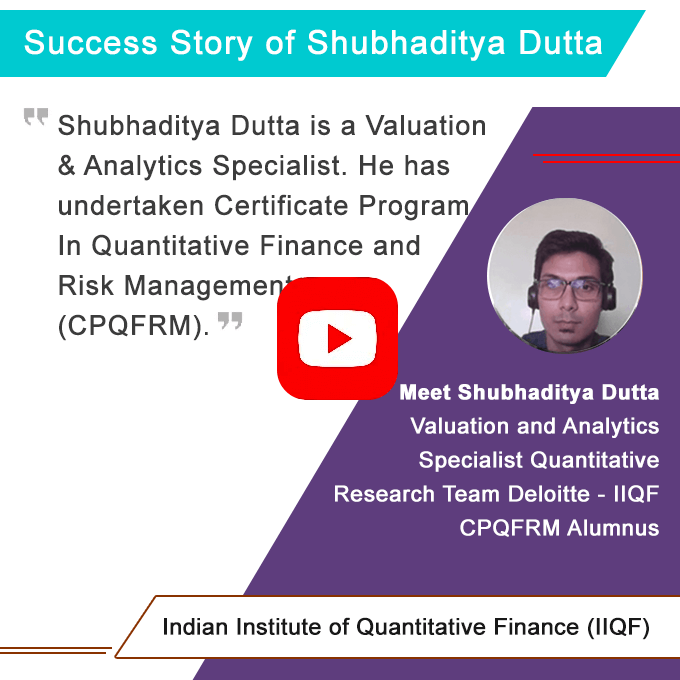
Shubhaditya Dutta
"I had attended the Certificate Program in Derivative Valuations and Risk Analytics (CPQFRM Lateral Entry) conducted by Indian Institute of Quantitative Finance. I was previously working with a Registered Investment Advisory (proprietary firm) as a Quantitative Analyst. This program is very relevant for risk professionals with a specialization in OTC valuations. The content of the course is very practical for various asset class derivative valuation models and the codes and resources of the model can be utilized to build a foundation for Derivative Valuation Modelling. Lectures are very interactive with its content being useful for python modelling from scratch and prepare for Valuation and Model Validation quant roles... "
Ganesh Gopal Shetty
A big thanks to IIQF team for designing and conducting the program. It was truly a rewarding experience and more than met my expectations. Must also appreciate IIQF for the team of faculty they have onboarded-each one an expert in his domain. They were very generous with sharing their industry experience and made sincere efforts to make the course engaging and insightful.
Would like to give a big shout to the faculty!
Also, my congratulations to the bank for imparting this industry relevant training to its officer. Much appreciated and highly recommended.
Finally, it was a pleasure to be part of this batch and to make new friends.
Ram Dhan R Kumhar
I am very grateful to the IIQF and team, who have designed and delivered the very best for us.
it was a very great learning experience for me, which was more than my expectations, A lot of things i have learnt during the journey. Among the Python coding are very new for me, i have learnt a lot of things in it, I also added to them, i learnt model and valuation that was very new grately designed.
Over all it's a combo of FRM. I am very pleased with the faculty members .... Milan sir, Rajat sir, Rishabh sir and Amit sir, Edelbert sir, ujawal sir, Prashant sir and very grateful to Nitish sir who pleasantly coordinate the program, it's a great program for us which makes value addition to me other colleges.
Lastly I will never forget the prestigious memory which i spent with my colleagues please keep in touch.

Shyam Nayma
"I had attended the Program in Derivative Valuations and Risk Analytics (CPQFRM Lateral Entry) conducted by Indian Institute of Quantitative Finance. Before joining I was working with one the broking firm for a long time and was looking for change the field. IIQF's relevant & up to date program helped me a lot in sharpening my skills and getting desired profile at NOMURA. I would highly recommend this program for its content, which is very relevant for professionals in finance & risk. Additionally Nitish Mukherjee from IIQF has put in lots of efforts to share & recommend my profile to various organizations and finally I got opportunity to work with Nomura, where also my profile was considered after Nitish's personal recommendation."

Nimisha Sharma
First of all I would like to thank you for providing me a chance of being part of Derivatives Valuation and Risk Analytics (CPQFRM Lateral Entry) program offered my IIQF .It is indeed incredibly informative and value added program for people like us, who are aspiring to make career in the field of risk analytic's and Quantitative Modelling .The personal guidance given by Abhijit Sir and other faculty members are rarely found and was extremely helpful.

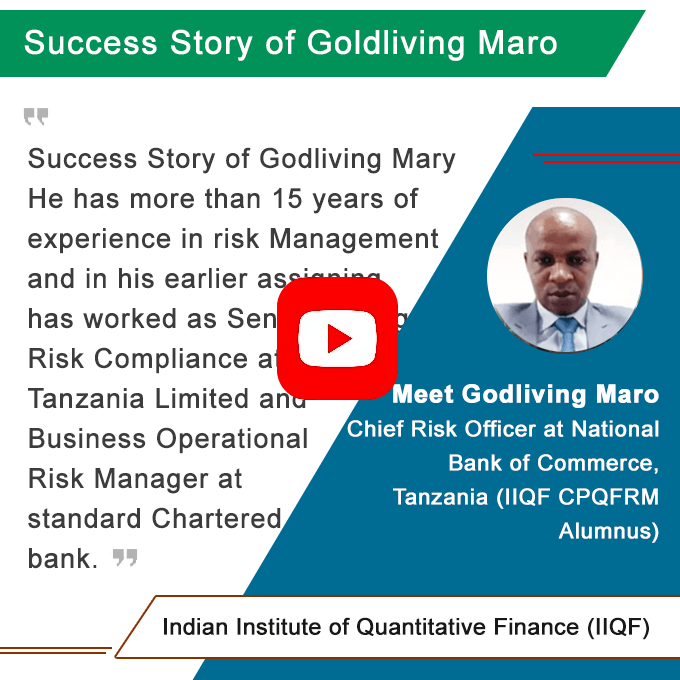
Godliving Maro (CPQFRM participant)
"The course was excellent, I would peenally continue selling it in Tanzania."
Faculty
Ritesh Chandra
CFA, MBA from IIM Calcutta and B Tech from IIT Kanpur. He has more than 14 years of experience in Credit Risk, Corporate Finance & Technology and has worked in India, China & Canada in a variety of roles. He is currently working as a Group Executive Vice President - Corporate Banking Risk in a large private sector bank in New Delhi. Earlier he worked with Barclays Bank as AVP – Wholesale Banking Risk Analyst for an INR 20bn portfolio covering Working Capital facilities, Term loans / ECB, Trade Finance and Derivative products.
Srijoy Das
MSc. Finance from London Business School, B-Tech from IIT Kanpur. He has more than 15 years of experience in Quantitative analysis and research that includes areas such as Derivatives Pricing, Market and Credit risk and has worked in India, USA & UK in a variety of roles in international banks and consulting firms. His more recent projects over the last 4 years include model risk assessment of counter-party risk models and regulatory stress testing (CCAR, EBA) models for leading investment banks. Further he is a thought leader and a scholar who likes to connect with, influence and inspire his audience through writing, speaking, lecturing and debating and using a world class network of resources that include theories, best practices and subject matter experts..
Rupal
B.Tech from IIT, Kanpur and Executive MBA from IIM Kozhikode. Rupal has a vast experience of more than 12 years in various areas of finance. He currently works as Vice President, Fixed Income at one of the largest International Bank for their Corporate Investment Banking Division. Prior to this he was working as Assistant Vice President at Credit Suisse, Investment Banking Division. He has also been a regular internal trainer in the organizations that he has worked in.
Ujwal Dinesh
MBA from IIM-Calcutta, FRM, CFA, BE (NIT Surat), PG Diploma in Securities Law. He is currently working as a GM of one of the top MNC IT Company leading their Risk Management team and Derivative Valuations team. Earlier he was working with one of the top four Wall Street Investment Banks as Credit Analyst where he is responsible for structuring and recommending exposure for fund-based, non fund-based and derivative facilities. He has experience of statistical modelling of short-term interest rates in India. He has been a visiting faculty at leading business schools.
Edelbert D'Costa
Edelbert brings over 19 years of experience in banking, asset management and capital markets. He has been a part of the founding team of Yes Asset Management. Some of his earlier assignments have been with ING, Pramerica (Prudential of U.S.A.) and ICICI. He was entrusted the responsibility of starting the Investment Risk function at ING Investments India where he designed and built a formidable system to track and monitor key investment risk parameters thereby making sure that investment managers don't deviate from their scheme objectives. On the back of this achievement, his involvement was sought in projects at the Asia-Pacific level. He has been a member of various investment committees, valuation committees, risk committees and product committees where his inputs were sought in the areas of financial derivatives, investments and risk management. Prior to joining ING, he set up the derivatives and alternate research desk at Ambit Capital, the broking arm of the Ambit group, a leading boutique investment house. Here he crafted successful strategies involving exchange traded futures and options.
Keshav Jain
Keshav has done his Btech from IIT Kharagpur. He has also done his CFA and FRM. He currently works as an AVP in a top International Bank. He has worked across various investment banks and financial institutions in the areas of financial modelling, M&A, risk management, risk advisory, derivatives research and financial analysis.
Sanjay Bhatia
15 year BFSI Risk Management & Model Implementation Work Ex. Across Corporate, Institutional & Investments Banking. Director in UBS - Risk Modelling & Analytics, Model Risk Management & Control, Chief Risk Office (CRO) Function. MBA-Finance & MSc in Machine Learning & Artificial Intelligence from Liverpool John Moores University (LJMU). Post-Graduate Diploma in Machine Learning & Artificial Intelligence from IIIT-Bangalore. Domain SME on Credit Risk , Derivatives Counterparty Credit Risk, Derivative Pricing, Stochastic Modelling, Stress Testing. ML Expertise (Teaching ML for Quantitative Finance & Risk Management). Financial Prediction (Regression & Classification ) - Lasso/Ridge Regression, CART Decision Trees, Ensemble Learning (Bagging & Boosting) & Support Vector Machines (SVM). Financial Time Series Forecasting - (Recurrent) Neural Networks, RNN-LSTM, RNN-GRU, Hybrid-RNN-LSTM-GRU. Financial Instrument Pricing - Non-Linear & High Dimensional Derivative Pricing using Neural Networks. ML Model Optimization – Hyperparameters Tuning K-Fold Cross-Validation, Stochastic Gradient Descent, Convergence etc. Regulatory & Industry ML Adoption, Challenges & Use Cases – Model Explainibility, Performance Evaluation & Testing.
*The faculty listed is indicative only. Instructors may be drawn from our broader teaching pool, and we reserve the right to include faculty members beyond the current pool as required.
Certificate Program in Quantitative Finance and Risk Management
Modern Investment Finance is hugely dependent on the implementations of the theories and techniques of financial engineering. Financial Engineering, or Quantitative Finance as it is alternately known, is a multidisciplinary field involving the application of theories from financial economics, physics, mathematics, probability, statistics, operations research and econometrics using the methods and tools of engineering and the practice of computer programming to solve the problems of Investment Finance.
Generally the language of choice for Quant implementations traditionally has been C++ along with tools like Matlab, Mathematica, Stata, etc. However, of late Python language has become more popular.
Quantitative Finance and Risk Management has emerged as a very prospective career prospect for people with strong mathematical background like those coming from engineering, mathematics, statistics, physics or econometrics background. The best of the global financial institutions like Investment Banks, Hedge Funds, etc. hire people having strong quantitative skills for “Quant” jobs. This is also a very rewarding and exciting career option for such people as there is ample scope for applying their numerical and creative skills to design new things, be it like devising new investment strategies or be it structuring new financial instruments or be it finding methods to value them. They are continuously competing with their peers and some of the best minds in the market and have to out-perform them to generate superior returns, which is intellectually a very challenging work, and this makes it all the more thrilling.
Brief CPQFRM® Courses Outline
-
Primer 1Introduction to Programming (Optional)
- Programming in Python
-
Module 201Introduction to Investment Finance(Compulsory)
- Financial Markets and Products
- Financial Economics
- Fundamentals of Fixed Income Instruments
- Fixed Income Mathematics
- Derivatives Products and Strategies
- Financial Institutions
-
Module 202Introduction to Financial Mathematics (Compulsory)
- Linear Algebra
- Calculus Review
-
Module 203Introduction to Probability & Statistics(Compulsory)
- Probability Theory
- Probability Distributions
- Descriptive and Inferential Statistics
-
Module 204Machine Learning for Quantitative Finance (Compulsory)
- Introduction to Machine Learning
- Supervised Learning
- Regression Models
- Time Series Models
- Volatility Forecasting
- Unsupervised Learning
-
Module 205Stochastic Processes (Compulsory)
- Basic Stochastic Processes
-
Module 206Numerical Methods (Compulsory)
- Monte Carlo Simulation
-
Module 207Derivatives Valuations (Compulsory)
- Implementing Equity Options Pricing
- Implementing Currency Derivatives Pricing
- Implementing Interest Rate Derivatives Pricing
-
Module 208Risk Analytics 1 (Compulsory)
- Introduction to Financial Risk Management
- Market Risk Management
- Credit Risk Management
-
Module 209Risk Analytics 2 (Compulsory)
- Operational Risk Management
- Liquidity Risk Management
- Investment Portfolio Management
Admission Process in CPQFRM® Program
-
Send Your Application
-
Get on a call with a counsellor
-
Wait for Application Acceptance
-
Pay the fee & join the upcoming batch
Finance your Study
Educational Loans
We are very happy to help you progress to greater heights in your career in every way possible. Education loans available at 0% interest for full time Indian residents. Easy EMI plans available.
Student Aid
Encourages the full time students to enter this domain, benefits, if you are still pursuing formal education.
Get Answers
-
What are the prerequisites for this program?
Undergraduate degree in finance / engineering / mathematics / statistics / physics / economics / econometrics / chartered accountancy / computer science / MBA / CFA / FRM / PRM. Proficiency in spoken and written English. Basic knowledge of Statistics. Working knowledge of Excel Computer and an internet connection. We teach in Windows based platform. Mac users will need to Install Windows in Parallels Desktop for Mac.
-
Is the program suitable for people having no background in finance?
While a prior background in finance, particularly knowledge of Financial Markets, Financial Products, etc. will be useful. However, the required areas of finance are taught in the course as well, so participants from non-finance background can also join this course. In fact, at least half of the participants of this program is from non-finance background and they have completed this quite successfully.
-
Is the program suitable for non-programmers?
We use a lot of Python in this course for teaching practical implementation of the models. So, participants having prior programming background definitely have an advantage.
For participants who do not have a programming background, they will need to attend a primer module on basic Python Programming. For registered participants of the course, when you join the course, you get access to a Primer module on Python.
The Python primer module is designed for people who do not have any kind of prior programming background and want to learn programming for developing applications related to finance. The aim of this module is to teach python in an easy, lucid and structured way so that people coming from even no-technical or non-programming background can learn and use the python language. -
Who should attend?
Finance and Banking Professionals – those who aspire to grow into advanced analytical roles in Quant analytics, Derivative Pricing and Valuation, Model Validation, Treasury, Financial Risk Management, Compliance, Risk Consulting etc.
IT Professionals – those who aspire to work in International Banks, Hedge Funds and other leading Financial Institutions in Quant Analytics or Financial Risk Management domains or wanting to lead projects in IT companies for the above-mentioned domains.
Risk Management and Consulting Professionals – those who aspire to grow into senior roles by gaining a deeper wholesome knowledge in this fields particularly in the area of quantitative risk management.
Students – Students from Engineering, Mathematics, Statistics, Economics, Finance, Commerce etc. background who aspires to work in International Banks, Hedge Funds, Consulting firms etc. in advanced analytical roles in Quant analytics, Derivative Pricing and Valuation, Model Validation, Treasury, Financial Risk Management, Compliance, Risk Consulting etc. -
How is the course delivered?
This program is conducted as a comprehensive online course offered via online live interactive lecture sessions on weekends. All lectures are recorded also and participants gets access to view the lecture recordings as well.
-
What is covered in the course?
Coverage of relevant theoretical areas of Mathematics, Statistics, Financial Markets and Products, Derivative Instruments, Trading Strategies, Payoffs, Option Greeks etc. Coverage of relevant areas of Machine Learning topics and their practical implementation in Python.
Machine Learning for Quantitative Finance, Monte Carlo Simulation Methods both theory and implementation in Python. Valuation of Equity Derivatives, Interest Rate Derivatives, Currency Derivatives, Commodity Derivatives, Swaps both deep understanding of the models and learning the practical implementation and modelling in Python. Deep Coverage of Financial Risk Management areas, Market Risk, Credit Risk, Liquidity Risk, Operational Risk, Basel, FRTB, Dodd-Frank, Performance Attribution etc. both theory plus practical modelling. -
Who are the faculty?
The course is taught by highly acclaimed Quant and Risk Management practitioners who have worked with topmost global investment banks and firms in New York, London, Singapore, Sydney and more, with academic background from some of the world’s top universities like Stanford (USA), Columbia (USA), London Business School, IIM, IIT, ISI, etc.
-
Will certificate be awarded on completion of the program? What are the certification criteria?
The participant becomes eligible to get the certificate on completion of a set of capstone project assignments that is given at the end of the program, participants who attend and follow all the lectures should be able to complete the project. To get the certificate the participant will have to complete and submit the project.
-
Is there any placement support?
We have dedicated placement team who provides strong support to all successful participants for getting relevant jobs in International Banks, Hedge Funds, Consulting Firms, IT Companies and other financial institutions.
You may work in Quantitative Research & Analysis, Development of Quantitative & Analytical Software, Building Valuation Models, Model Validation, Derivatives Structuring, Quant Trading, High Frequency Trading, Algorithmic Trading, Derivatives Trading. -
What is the course calendar?
This course is offered 3 times in a year.
-
How long has this programme been around for?
The first cohort of this program commenced in 2009.
-
What programming language does this program use?
This program is entirely taught using Python.
-
What mode of payments do you accept?
We accept all online payment modes like Bank Transfer, Credit Card, Debit Card, UPI
-
Is EMI facility available?
Interest Free EMI payment option is available through our NBFC partners.
Similar Courses
NEED HELP?
You can call us on +91-8976993621 or email us your contact details if you would like a call back
(This service is normally available between 9.00 AM and 9.00 PM all the day. At all other times, please submit an email request.)