

Career Opportunities in Machine Learning in Quant Trading
Navigate ML careers skills and competencies in Quants, Risk & Financial Management
Embark on a journey to unlock success in the realm of "Career Opportunities in Machine Learning in Quant Trading." In this guide, discover pivotal questions asked in interviews, accompanied by insightful answers tailored to help you navigate the intricacies of ML careers in Quants, Risk Management, and Financial Management, ensuring you are well-prepared to seize coveted opportunities in the quantitative finance industry.
1. Can you share and elaborate on the ML use cases for Algorithmic/Quantitative Trading problem sets?
Proprietary Trading
In-House Trading & Profit-Making Strategy
Arbitrage Driven Trading Strategies
- Bet on price differential b/w >=two markets. Simultaneous & same value transactions
- Statistical Arbitrage
- Volatility Arbitrage
- Index Arbitrage
- Automated Scalping
Frequency Driven Trading
- High Frequency Trading
- Ultra-High Frequency Trading
- Market Making - Based on order-flow (sell side) & tick/quote info analysis (buy-side)
Low-Latency Trading
- Provides competing bid/offer
- Trades on demand/supply imbalance
- Front-run large orders in the network
- Co-located in exchange and very sensitive to speed
- Talk-to-Trade ratio
Pair Trading Technical
Trend Based Trading
Trend Following Systems – Bet on trend signals like rally-continuation
Short Holding Period
Milli or Nano -Seconds to minutes
Factor Models
AGENCY TRADING
Client Execution & Brokerage Servicing Strategy
- Volume Weighted Average Price (VWAP)
- Total Weighted Average Price (TWAP)
- Market Making Quote & Tick Analysis Based
- Directional Calls High-Freq. Analysis Based
- Dark Pool Execution
- Order Slicing Volume-Curve Based
- Smart Order Routing
- Novel Algos Inline, Aggressive, Passive, Basket Execution
2. Can you highlight the complexities of building an ML-based Algorithmic/Quantitative Trading application?
- Extremely poor observability of the trading environment
- Opaque trading strategies followed by market participants;
- Confidential trading information on companies.
- Minimising the subjective bias and the noise in retrieved & processed trading information.
- Significant time correlation complexities to deal with
- Information retrieved by the RL agent at each trading time step should be considered sequentially as a series of information rather than individually.
3. Can you define Algorithmic Trading design using ML-based Deep Reinforcement Learning Neural Networks?
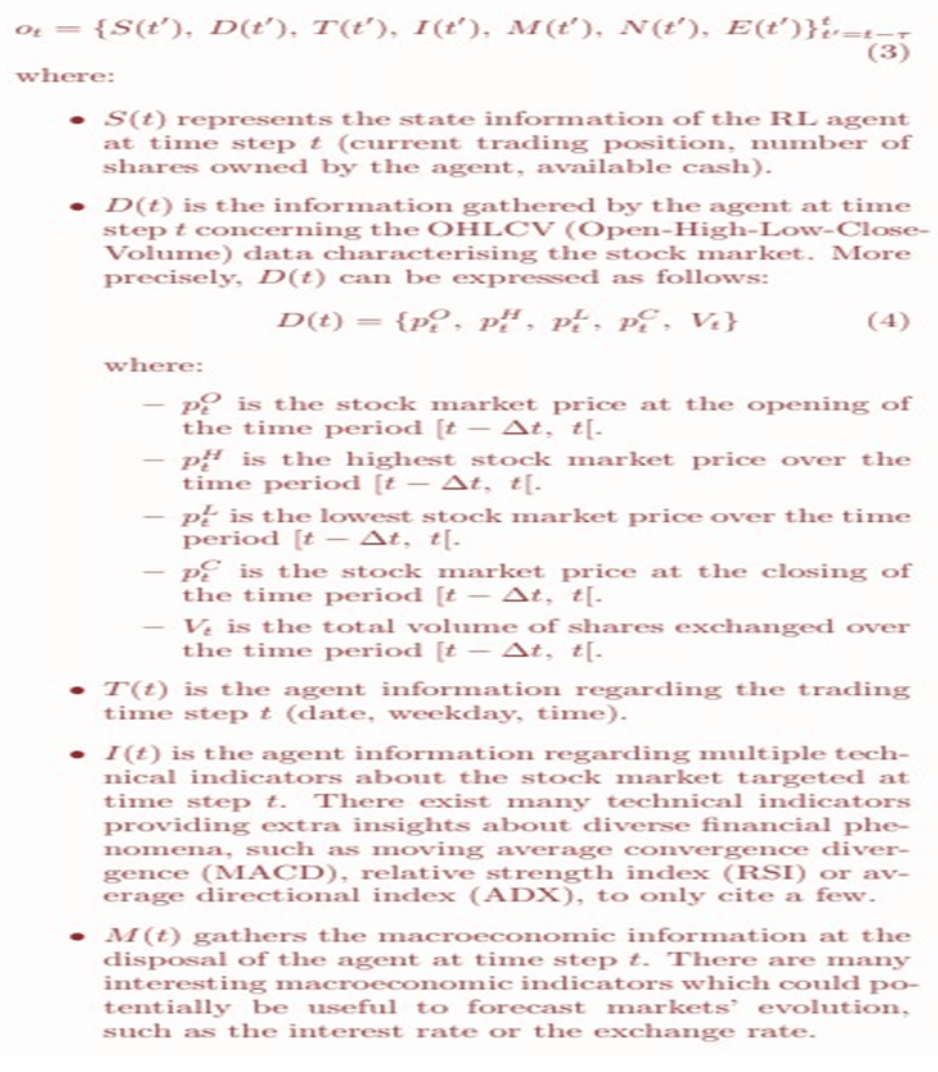
- Algorithmic trading can be seen as sequential learning problem of an agent interacting with the unknown trading environment to draw useful observations and take actions for maximising the rewards.
- Complex trading environment is denoted by ot ? O.
- Observation space O should encompass all the information capable of influencing the market prices. observation ot has to be considered as a sequence of both the information gathered during the previous t time steps (history) and the newly available information at time step t .
4. Can you define technical indicators in ML DRL-based Algo-Trading Application?

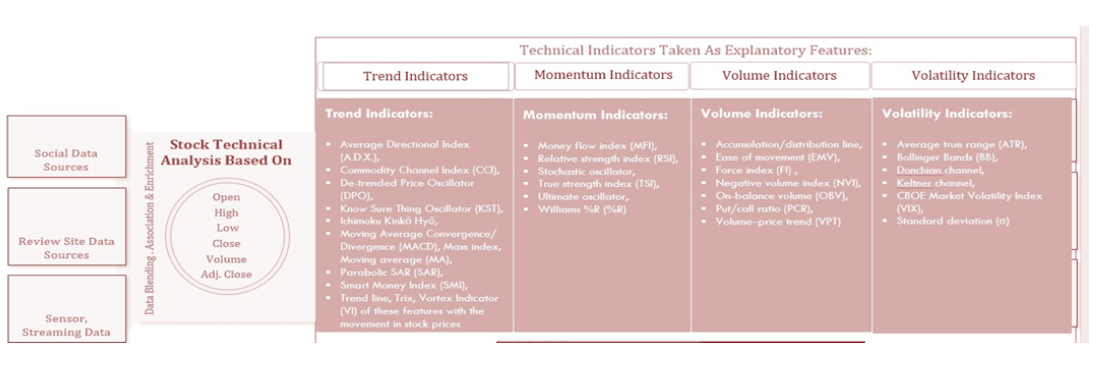
- I(t) is the agent information regarding multiple technical indicators about the stock market targeted at time step t .
- There exist many technical indicators providing extra insights about diverse financial phenomena, such as moving average convergence divergence (MACD), relative strength index (RSI) or average directional index (ADX), to only cite a few.
5. Can you define sentiment indicators in ML DRL-based Algo-Trading Application?

- N(t) represents the news information gathered by the agent at time step t . This news data can be extracted from various sources such as social media ( Twitter, Facebook, LinkedIn), the newspapers, specific journals, etc.
- Complex sentiment analysis models could then be built to extract meaningful quantitative figures (quantity, sentiment polarity and subjectivity, etc.) from the news.
6. Can you call-out disadvantages of Deep Learning (Deep Neural Networks)?
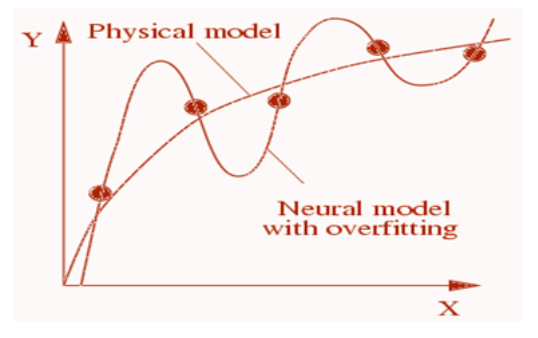
Deep Neural Network (DNN) Disadvantages
- Black-box models (lacks parameterization & estimation transparency)
- Overfitting (tend to over-predict and over-fit the data )
- Expertise for choice of input (need ML expertise to determine the Neural Network design elements & Hyperparameters )
- Training takes a lot of time (huge parameters to train hence computationally intensive & time consuming)
7. Can you cover a use-case RNN (Recurrent Neural Network) LSTM Architecture to solve a sequential learning task ?
| Data Extraction & Description: Sourced VIX i.e. S&P 500 Volatility Index [^VIX] using Yahoo Finance as an interface. | ||||
|---|---|---|---|---|
| Data Period: Spanning from 1st Jan 1971 to 30th Apr 2022 | Data Frequency: Daily VIX Index Price Values | Total Observations: 8146 records (250 trading days per year) | Total Columns: 7 'Open', 'High', 'Low', 'Close', 'Adj Close', 'Volume' | Final Column Used: 'Adj Close' is VIX price adjusted by averaging for last 1 hour |
| Data Exploratory Analysis & Visualization | ||||
|---|---|---|---|---|
| Seasonal Decomposition: Daily VIX Price Series ('Adj Close') - VIX Price, Trend, Seasonality & Residuals |
Averaging of % VIX Price Change Over 250 days rolling window to overcome Volatility Clustering |
Plotting VIX_mean 250 & its Distribution |
Correlational Scatter Plot b/w VIX_mean 250 & its lags |
ACF & PACF Plots VIX_mean 250 |
| Model Dataset Preparation | ||||
|---|---|---|---|---|
| Perform Stationarity Test AD-Fuller |
Apply Data Scaling Min-Max scaling on dataset |
Split Dataset Train (75%) & Test (25%) |
Visualise Periodic Spread Train Test Plot | Create a 3-d Tensor Needed for LSTM & GRU |
| Model Design, Implementation & Application | ||||
|---|---|---|---|---|
| Base Model Fit on Train & Predict on Test using Auto ARIMA |
RNN Family ML Models LSTM, GRU & Hybrid LSTM-GRU |
Tuning RNN Hyperparameter No-of-Neurons, Activation Function etc. for RNN |
Train RNN Variants Train using Validation Loss as Early Stopping Criteria | Apply RNN Variants Apply each RNN-family variants on Test Set |
| Model Performance Evaluation & Comparison | ||
|---|---|---|
| Model Epoch Training Evaluation Train v/s Validation RMSE & Loss |
Test Prediction Accuracy Plotting Projections v/s Actuals for Test Set |
Model Complexity & Accuracy Evaluation Measures: Trainable Parameters, Loss, RMSE & R-Square |